

A speech model hands you a transcript or a label and a confidence score. That tells you what it decided. It does not tell you why, whether the reason holds up, or who it quietly fails. AudioLens is a workbench for asking those questions directly, on real audio, one prediction at a time.
A transcript is not an explanation
Say Whisper turns "the cat sat" into "the cap sat". The usual next steps are familiar: listen to the clip again, guess that the consonant was soft, maybe write a script to add noise and see if it gets worse, maybe write another to check whether the error rate is higher for some speakers. Each question needs its own code, its own model run and its own plot, and the answers never end up side by side.
That is the gap AudioLens fills. Speech models are hard to debug from the outside because the evidence you need is spread across the waveform, the attention heads, the hidden layers and the dataset. Looking at any one of those alone rarely settles anything.
What AudioLens is
AudioLens is an interpretability and debugging workbench for speech models. It is the audio counterpart to Google PAIR's LIT (Learning Interpretability Tool), which covers text and tabular models, and it builds on ECHO, an MIT-licensed tool first released as LIT for Voice.
The core idea is simple: one clip plus one model is one datapoint, and every analysis attaches to the same timeline. You upload a clip once, pick a model once, and then move between views without re-running anything:
- Saliency draws an attribution map over the waveform: which stretches of audio pushed the prediction.
- Attention shows per-layer, per-head attention weights.
- Embeddings project clips into 2D or 3D, with clustering and nearest neighbours.
- Perturbation applies a controlled change (noise, time masking, pitch shift or time stretch) and re-runs the model.
- Diagnostics sweeps a batch of files to separate what was said from how it sounded.
- Layer probes find which layer best represents a property you can label.
- Jacobian Lens reads Whisper's decoder layers as if each were making its own guess.
- Fairness slices compare performance across accent, speaker or any metadata column, with bootstrap statistics.
It ships with Whisper for transcription and a Wav2Vec2 model for emotion classification, and it can register other Hugging Face models that fit a Seq2Seq, CTC or audio-classification architecture.
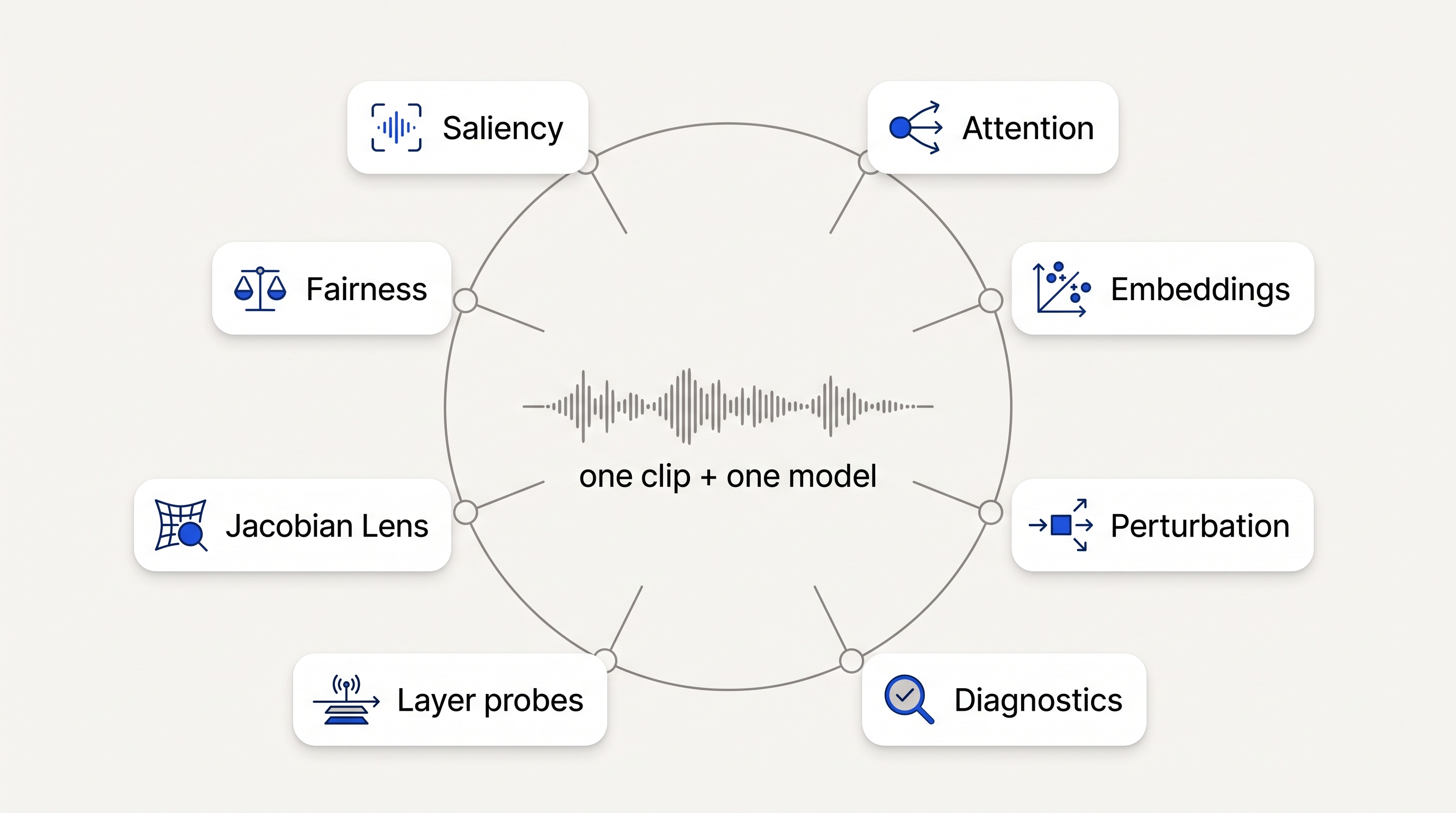
One clip, one timeline, many lenses
Why it is useful
You see what the model listened to
A saliency map turns "the model got it wrong" into "the model leaned on this half second and ignored that one". Put next to the attention view for the same clip, it shows whether the model was looking in the right place when it emitted the wrong token.
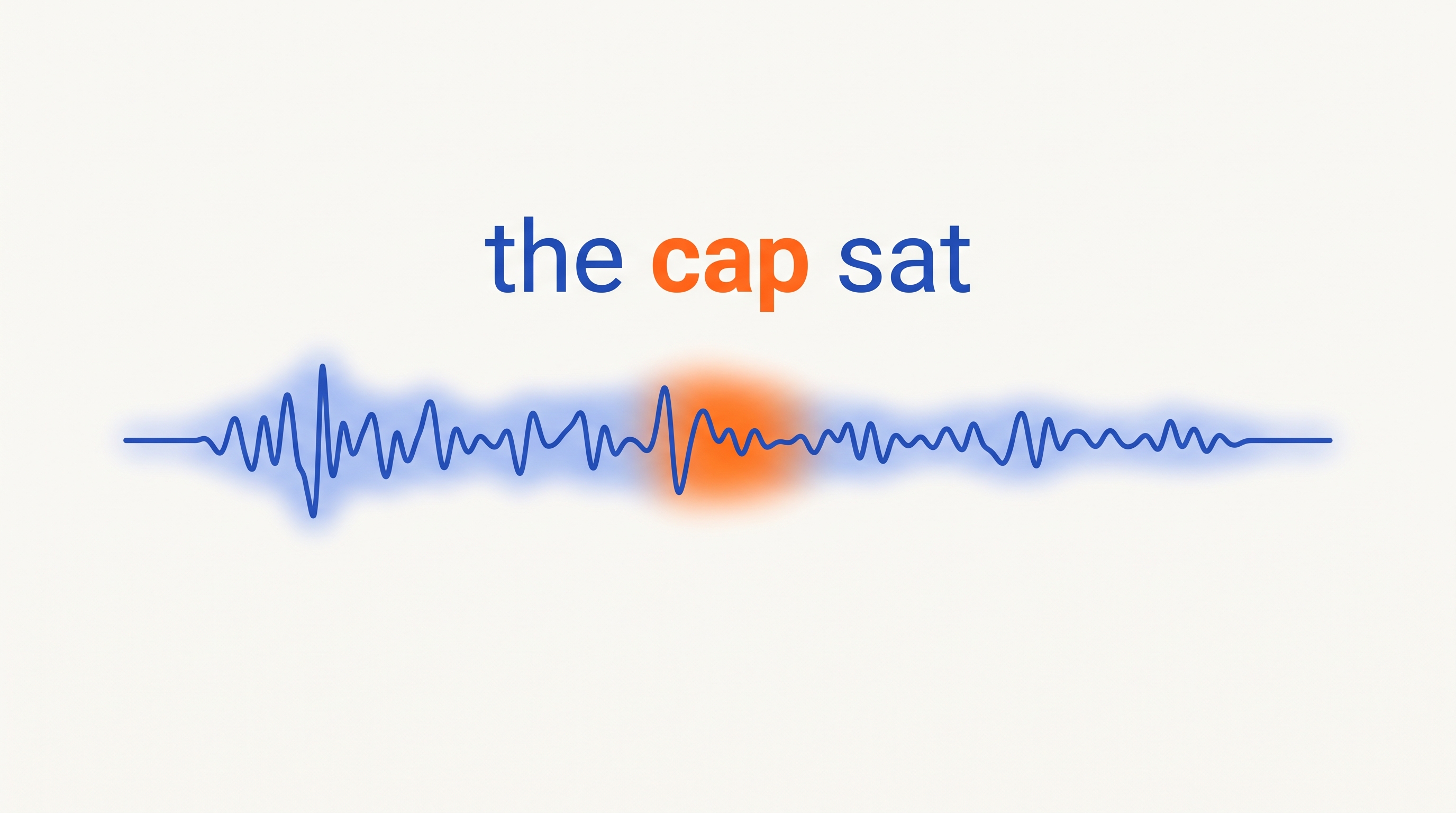
Saliency ties the wrong word to the audio behind it
You test instead of guessing
An attribution map is a hypothesis, not a fact. AudioLens lets you check it: perturb the region the map calls important and see whether the prediction actually moves. If deleting the "important" audio barely changes the output, the map for that clip should not be trusted. Robustness stops being an opinion and becomes a before-and-after comparison.
You find where knowledge lives
Layer probes train a small linear classifier on each layer's hidden states and report which layer predicts a property best, against a shuffled-label control and a majority baseline. The Jacobian Lens does something similar for tokens, showing how a guess like "car" becomes "cap" and then "cat" as it moves up the decoder. Both answer a question a transcript never can: where in the network something is decided.
You measure who it fails
Speech models often do worse for non-native speakers and under-represented groups, and an overall error rate hides that. Fairness slicing splits a dataset by one or two metadata columns, compares each group against a reference group, and puts confidence intervals behind every gap, so a real difference can be told apart from noise.
It all happens in one place
Because every panel reads the same datapoint, a finding in one view leads straight into the next. That is the practical win: less glue code, fewer one-off notebooks, and evidence you can line up and compare.
Getting the most out of it
The panels are most useful chained together. A few patterns that work well:
- Debug a single wrong prediction
Start in Saliency to see which region drove the output, confirm it in Attention, then run Perturbation on that region. If the prediction flips, you have found the cause. If it does not, the map was misleading and you have learned that too.
- Audit a model before you ship it
Load a dataset with speaker metadata, run Fairness slices by accent or gender, and look at substitution, deletion and insertion rates per group. A high insertion rate with few deletions is the usual sign of hallucination. Follow up with Diagnostics to see whether the weak group is hurt by acoustics or by content.
- Compare two checkpoints
Run the same clips through both models and compare predictions, perturbation robustness and fairness gaps side by side. A fine-tune that lowers overall error but widens a group gap shows up immediately.
- Answer a research question
Use Layer probes to ask where a property such as emotion or speaker gender becomes linearly separable, and Jacobian Lens to watch token guesses form across decoder layers. Pair them with Embeddings to see whether clips cluster by the property you expect.
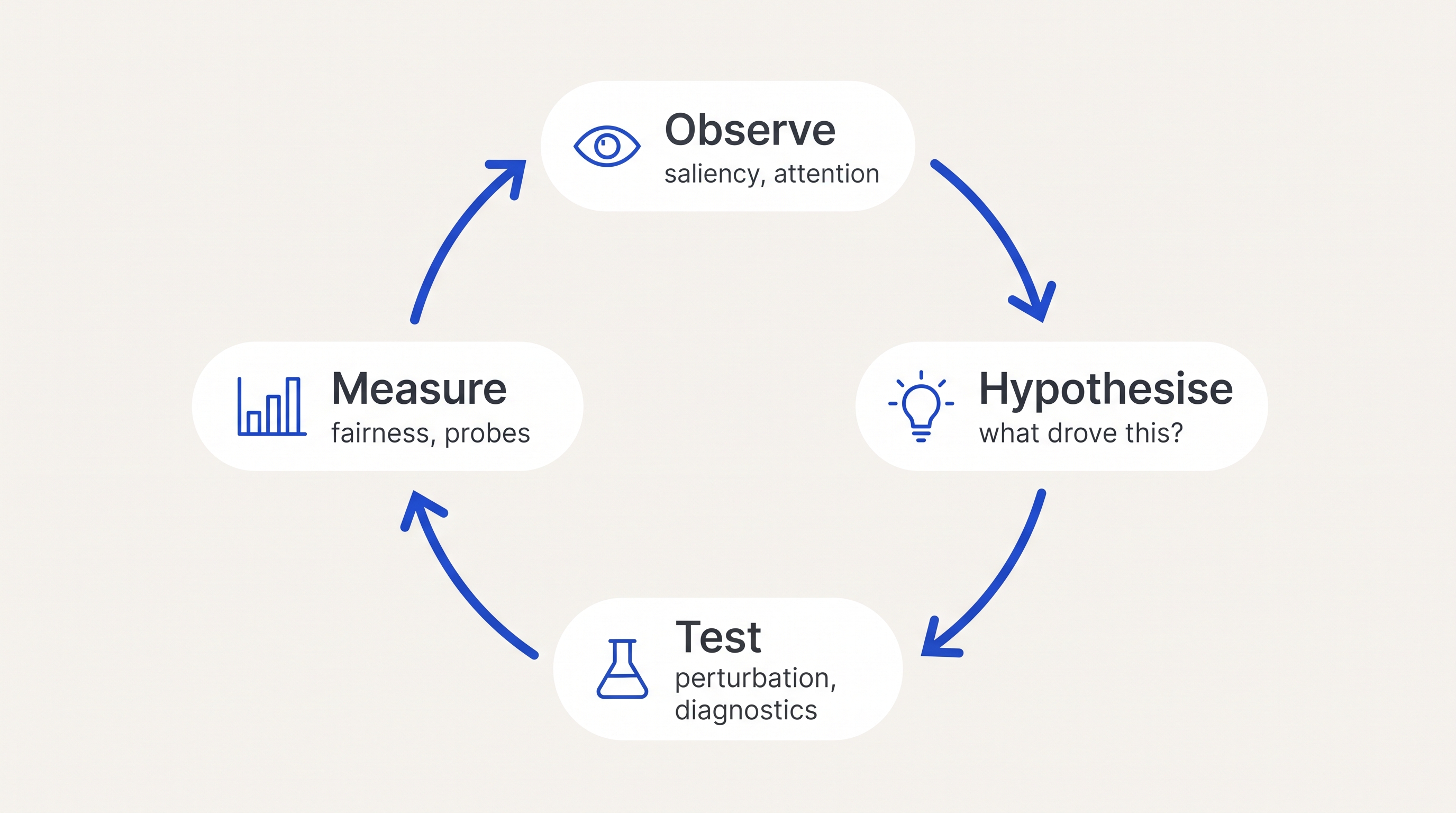
The investigation loop
A few habits make the results more trustworthy:
- Treat every saliency map as a claim to verify. Perturbation exists for exactly this.
- Read probe scores against their controls. Accuracy only means something when it clears the shuffled-label control and the majority baseline.
- Look at gaps with their intervals. A group gap whose confidence interval crosses zero is not yet a finding.
- Keep datasets in
Backend/data. Uploads expire with the session after 24 hours; built-in datasets fetched with the scripts stay put.
Where it stops
AudioLens is a research and debugging tool, not a transcription product. It does not run in real time, it is English-only (Whisper decoding is pinned to English and the emotion model is English-only), and it has no user accounts: everything is scoped to an anonymous session that expires after 24 hours. It is built for looking closely at predictions, not for serving them.