
Loading page
API control plane, Celery workers, Redis broker, shared storage.
AudioLens splits into a CPU-only control plane and a model-execution plane. The frontend only ever talks to the control plane — it never reaches a worker directly.
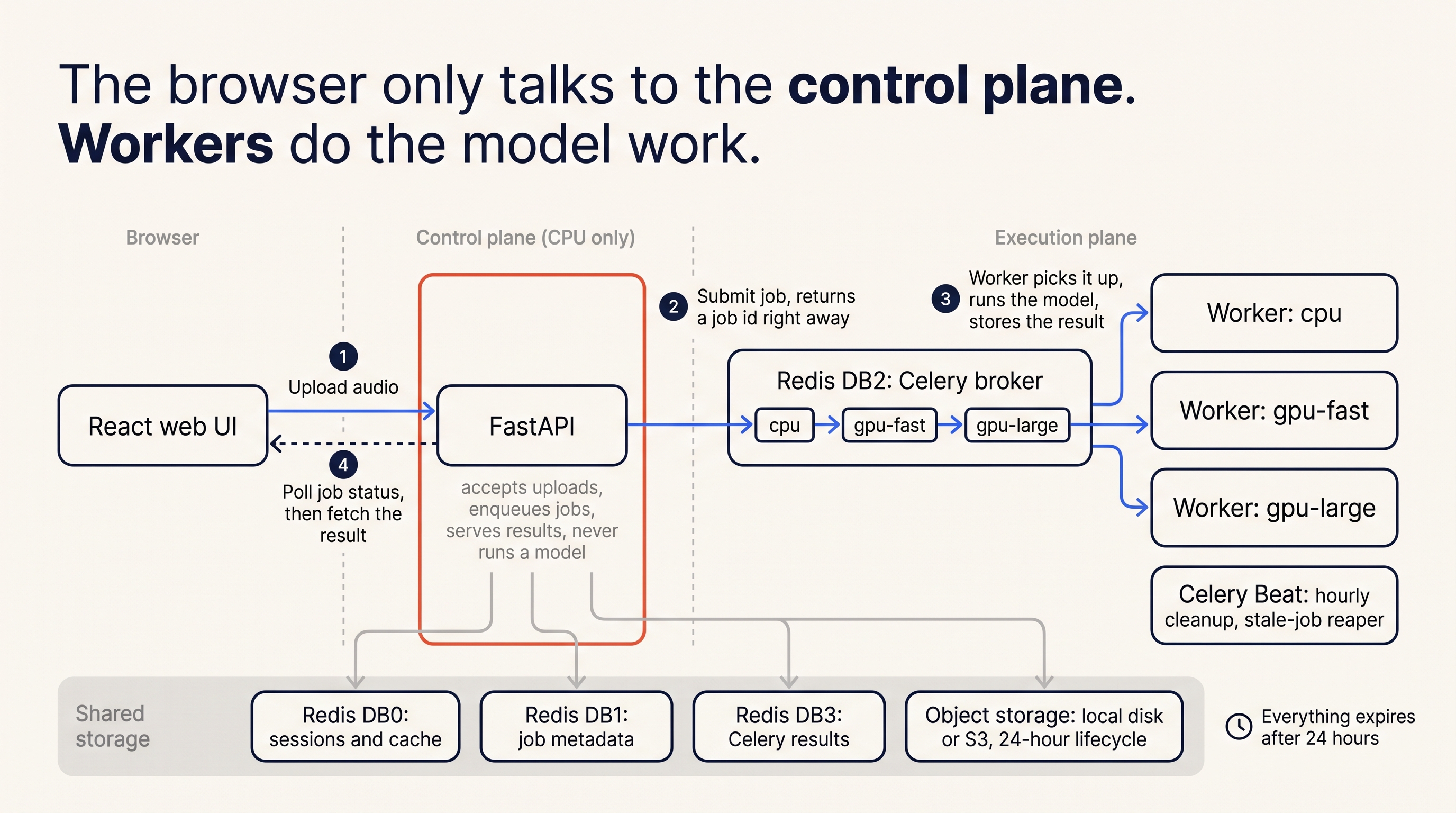
FastAPI is a CPU-only control plane: it accepts uploads, enqueues jobs, and serves results, but never runs a model itself. Celery workers are the model execution plane — they're the only processes that ever load a checkpoint or touch a GPU.
POST /upload stores the audio and returns an opaque audio_id. No
inference runs yet.
POST /jobs returns 202 immediately with a job_id, and publishes a
task envelope onto the appropriate queue.
A Celery worker downloads the audio to a temp dir, lazily loads the model if it isn't already resident, runs the operation, and stores the result.
The frontend polls GET /jobs/{id} for status, then reads
GET /jobs/{id}/result once it's done.
Job, upload, and result metadata expires after 24 hours.
Jobs are routed to one of three queues depending on which operation they run:
| Queue | Operations |
|---|---|
gpu-fast | prediction, embedding, hidden states, layer probing (Whisper Base, Wav2Vec2) |
gpu-large | attention, saliency, faithfulness, Jacobian Lens, anything on Whisper Large |
cpu | perturbation, audio features, linguistic-vs-acoustic sweep, fairness, cleanup |
No SQL database. Redis holds four logical DBs:
| DB | Holds |
|---|---|
| DB0 | Sessions / cache |
| DB1 | Job metadata |
| DB2 | Celery broker |
| DB3 | Celery results |
Uploaded audio and job results live in object storage — the local
filesystem by default, or an S3-compatible bucket in production — under a
24-hour lifecycle policy (echo-transient-artifacts-24h). Celery Beat runs
an hourly cleanup pass plus a stale-job reaper every 300 seconds.
Compose project name: echo.
| Service | Image / role | Ports | Notes |
|---|---|---|---|
redis | redis:7-alpine | 6379 | AOF persistence, noeviction, healthcheck |
api | Backend Dockerfile, CPU-only | 8000 | FastAPI, uvicorn --reload, healthcheck on /health |
worker-cpu | Backend Dockerfile, cpu variant | – | --queues=cpu --concurrency=2 |
worker-model-local | Backend Dockerfile, cpu variant | – | --queues=gpu-fast,gpu-large --concurrency=1 |
scheduler | api image | – | celery beat — must run exactly once |
worker-gpu | Backend Dockerfile, gpu variant, profile gpu | – | NVIDIA GPU reservation |
worker-amd | Backend Dockerfile, rocm variant, profile amd | – | /dev/kfd, /dev/dri, ROCm |
frontend | Frontend Dockerfile, dev target | 8080 | depends on healthy api |
Base images: python:3.11-slim (CPU/ROCm),
nvidia/cuda:12.6.0-runtime-ubuntu22.04 (GPU). Frontend: node:20-alpine
for development; the production target is nginx:alpine on port 80 with
SPA fallback. Containers run as non-root user appuser (uid 1000).
Self-hosting for booting this stack,
Environment variables for every tunable above, and
Device selection for how ML_DEVICE picks CUDA, ROCm, MPS,
or CPU.