
Loading page
Add noise, shift pitch, stretch time, or mask audio and watch metrics move.
The perturbation lab applies a controlled transform to a clip, re-runs the model on the result, and lets you compare the prediction before and after — a direct robustness check rather than an inferred one.
Perturbation means changing a clip in a controlled way, such as adding noise or shifting pitch, and re-running the model on the result. Comparing the prediction before and after tells you directly whether the model's answer is robust to that change.
There are four perturbation types available today — noted explicitly here because marketing copy elsewhere may round this up; this page is the accurate count:
noisetime_maskingpitch_shifttime_stretch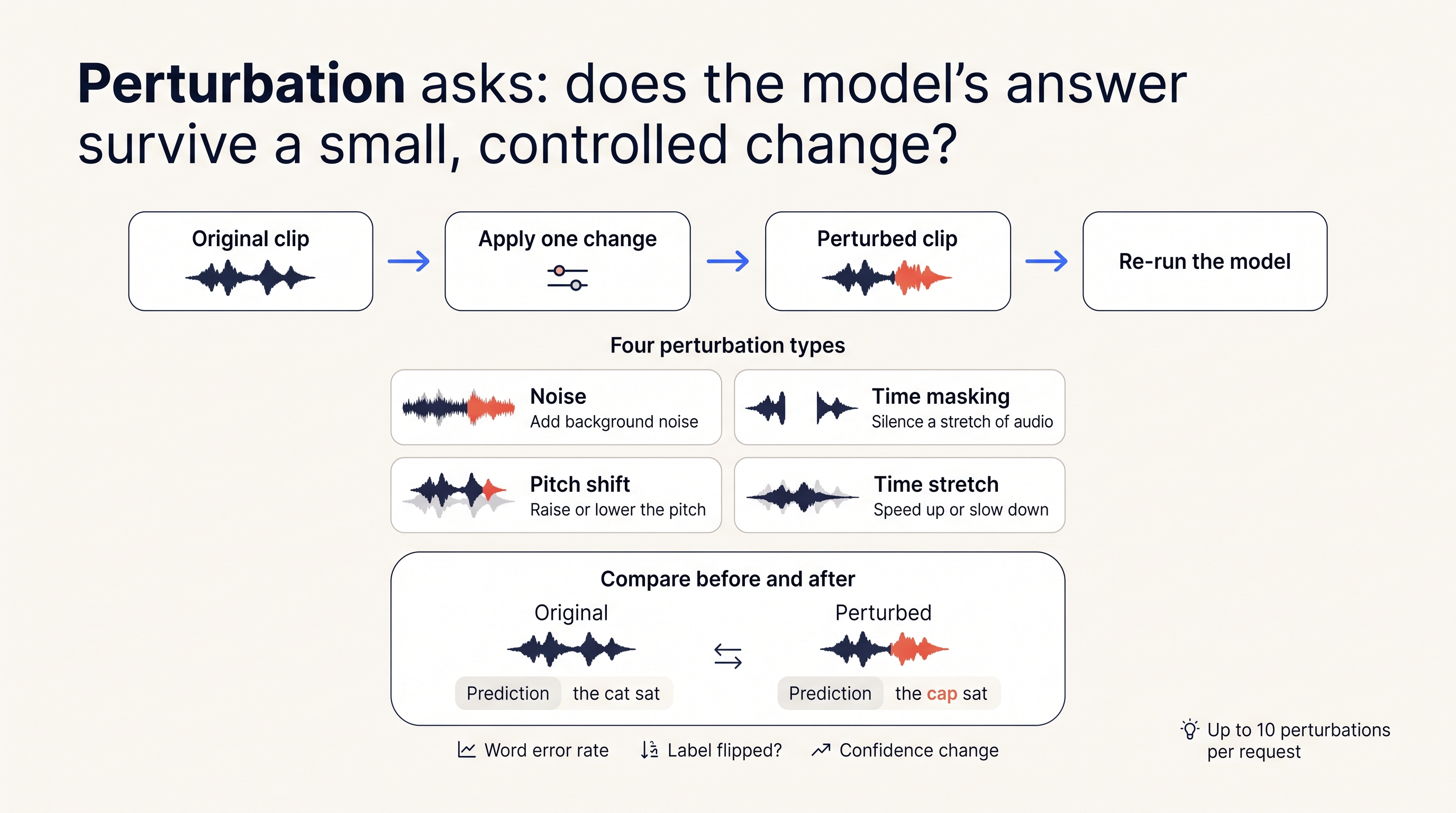
Up to 10 perturbations per request. Each generates a new audio variant, which is then run back through the model so you can compare its prediction against the original.
For each perturbation, the panel shows:
For transcription models the perturbed transcript is scored against a reference after Whisper's own text normalisation, so punctuation and casing don't count as errors:
| Metric | Meaning |
|---|---|
wer / cer | Word and character error rate (capped at 1.0). Scored against the dataset ground truth, or against the unperturbed transcript to measure self-consistency. |
substitutions, deletions, insertions | Edit counts behind WER, so you can see how the transcript degraded. |
insertion_ratio | Insertions ÷ reference words. High insertions with few deletions is the hallucination signature. |
For classification models the perturbed prediction is compared with the baseline prediction:
| Metric | Meaning |
|---|---|
confidence_delta | Change in top-class confidence versus baseline. |
label_flipped | 1 if the predicted label changed. |
js_divergence | Jensen-Shannon divergence between the perturbed and baseline probability distributions, in nats, bounded 0 to ln 2 (≈ 0.69). Symmetric and always finite. |
true_class_confidence_delta | Change in confidence on the baseline class. |
When several files are perturbed together, set-level accuracy, macro-F1, and macro-recall are also reported (they need at least 2 files).
This is the most direct robustness signal in AudioLens: instead of asking "what does the model attend to," perturbation asks "does the model's answer survive a small, controlled change to the input."