
Loading page
Train a linear probe per layer to find where a property is represented.
Layer probing answers a specific question: for some property you care about — speaker gender, accent, emotion, anything you can label — which layer of the model actually represents it best?
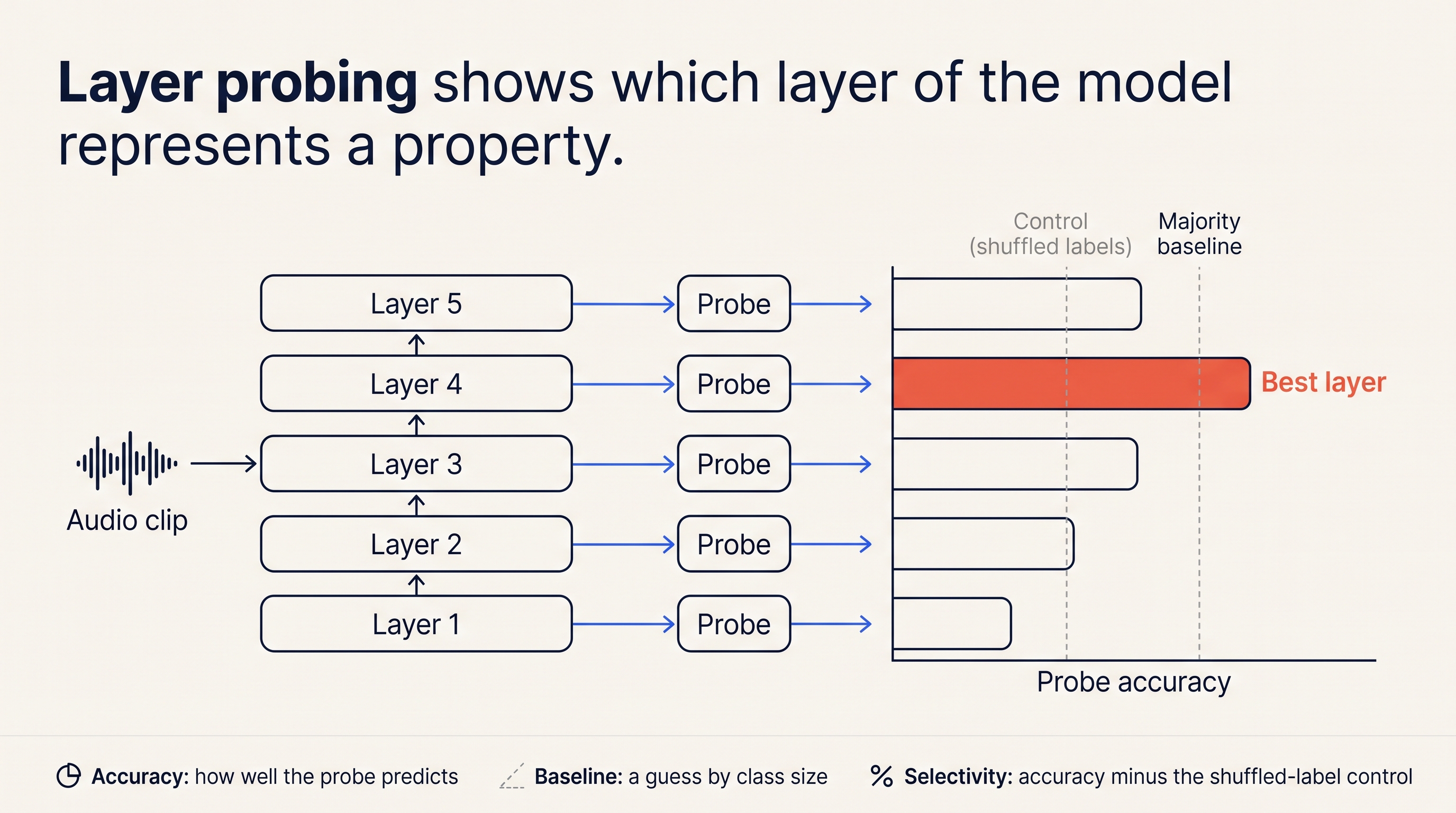
A probe is a small, simple classifier trained on a model's hidden activations to predict a property, such as speaker gender or emotion. If a linear probe can predict the property from a layer, that layer represents it. Repeating this at every layer shows where in the network the property emerges.
The layer_probe operation trains a small linear classifier — a
probe — on the hidden states from each layer independently, then
scores how well each layer's probe predicts the property. The result is a
per-layer view of where in the model that property becomes linearly
separable.
logreg — logistic regression.linear_svm — linear support vector machine.Each property is probed independently across all layers, using cross-validation so the reported score isn't just an artifact of the particular train/test split.
| Setting | Default | Meaning |
|---|---|---|
probe | logreg | logreg or linear_svm |
cv_folds | 5 | Cross-validation folds (2–10) |
project_dims | 256 | Random projection applied to each layer's vector before probing (0–1024; 0 disables) |
min_class_count | 5 | Minimum files a class needs to be included (2–50) |
include_control | on | Also train a control probe on shuffled labels |
Activations are mean-pooled per layer and standardised before fitting. Files
labelled empty, unknown, none, or n/a are dropped as unannotated, and
a property needs at least 8 usable files to be probed at all.
Read all three together — accuracy on its own can mislead:
accuracy — mean cross-validated accuracy of the probe.majority_baseline — the share of the largest class. Accuracy at or
below this means the layer carries no usable information about the
property, however high the number looks.selectivity — accuracy − control_accuracy, where the control is the
identical probe trained on shuffled labels. A probe that beats the
baseline but not its control is memorising training rows rather than
reading the representation.Each layer also reports macro-F1 and the accuracy's standard deviation across folds, and each property reports its best layer by accuracy and by selectivity.