
Loading page
Separate linguistic from acoustic influence on a prediction.
Diagnostics runs a linguistic-vs-acoustic sweep: a batch of controlled variants across several files, designed to separate how much of a prediction comes from what was said versus how it sounded.
A model's output can change because of what was said (linguistic content) or how it sounded (acoustics such as pitch, speed, or noise). Diagnostics sweeps controlled acoustic changes across a batch of files and compares the resulting damage against a control that removes words. That shows which of the two the model depends on.
Instead of perturbing one clip at a time, diagnostics sweeps a whole batch of files across one or more acoustic dimensions and looks at how predictions shift as a group — separating variation that tracks the content of the speech from variation that tracks its acoustics.
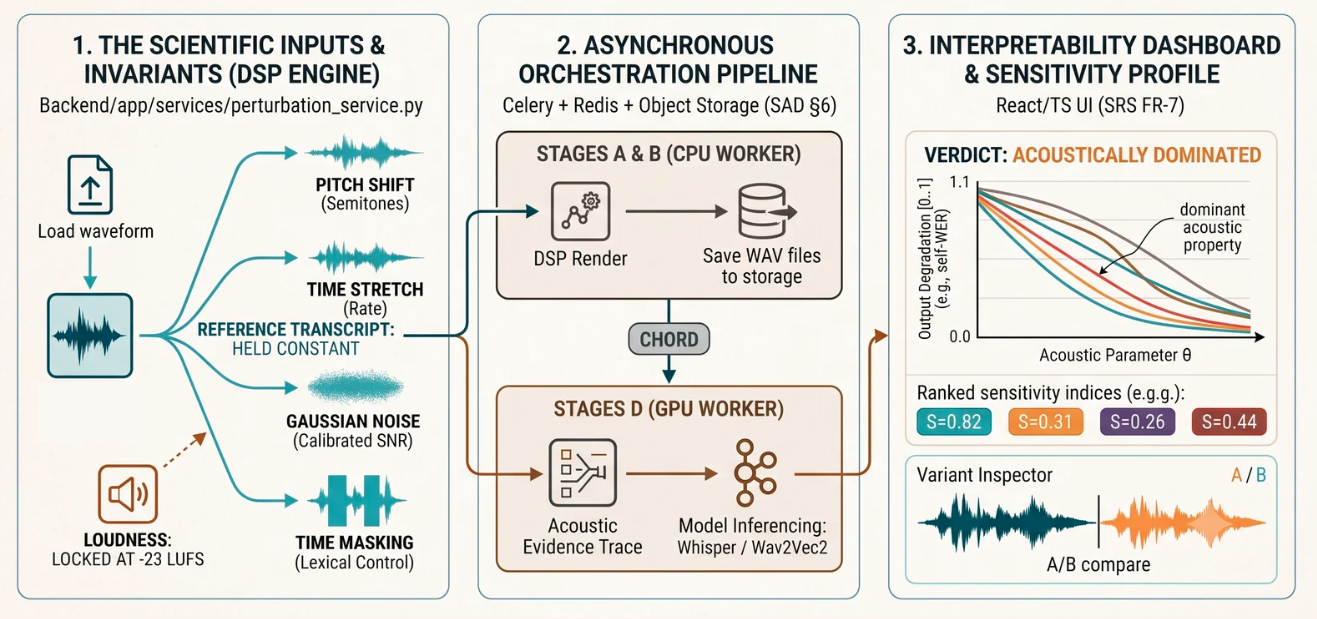
Read the diagram left to right: variants are rendered from one waveform (the reference transcript and loudness stay fixed), workers render and score them in the background, and the result lands as a verdict plus a degradation curve and sensitivity index per dimension.
The five available sweep dimensions are pitch, speed, noise, time_mask, and freq_mask — you choose between 1 and 5 of them per sweep, and the combination of files × dimensions is capped so a single request can't generate an unbounded number of variants.
Every variant is rendered at 16 kHz mono and loudness-normalised to −23 LUFS, so gain never confounds the result.
| Dimension | Unit |
|---|---|
pitch | semitones |
speed | rate (1.0 = unchanged) |
noise | dB SNR (repeated per step to average out randomness) |
time_mask | % of the clip masked |
freq_mask | Hz |
Each file also gets an identity control (unchanged audio) and, by default, a lexical control that removes about 30% of the words, which gives a reference ceiling for how much damage changing the content does.
For each dimension, the sweep produces a degradation curve: how far the output moves from the unperturbed baseline at each setting. That's self-WER for transcription models and output divergence for classification models, clipped to 0–1, with a bootstrap 95% interval per point.
sensitivity_index — the area under that curve, on a 0–1 scale. This
is what dimensions are ranked by.breakdown_theta — the setting at which degradation first crosses
50%, or none if it never does within the swept range.local_slope_at_identity — how fast the output starts to move near the
unchanged setting (local fragility).asymmetry and monotonic — whether degradation differs by direction
and whether it grows steadily.The overall verdict is based on the top dimension's sensitivity_index
(acoustic_influence) and its size relative to the lexical control:
| Verdict | Rule |
|---|---|
linguistically_driven | acoustic influence below 0.10 — acoustics barely move the output |
acoustically_dominated | the top dimension reaches ≥ 60% of the lexical-control damage |
mixed | anything in between |
inconclusive | no dimension could be isolated for the input |
linguistic_robustness is 1 − acoustic_influence.
Diagnostics is submitted as a job like any other analysis:
curl -X POST http://localhost:8000/api/v1/analyses/linguistic-vs-acoustic \
  -H "Content-Type: application/json" \
  --cookie "sid=<your session cookie>" \
  -d '{
    "audio_ids": ["<id-1>", "<id-2>"],
    "sweeps": ["pitch", "noise"]
  }'
The endpoint responds 202 Accepted immediately, before any variant
has actually been generated, with an estimate of the work ahead:
{
  "job_id": "…",
  "estimated_variants": 24,
  "estimated_seconds": 40
}
Poll the job the same way as any other analysis — see
REST API for the shared GET /jobs/{id} / GET /jobs/{id}/result pattern every panel in AudioLens uses.